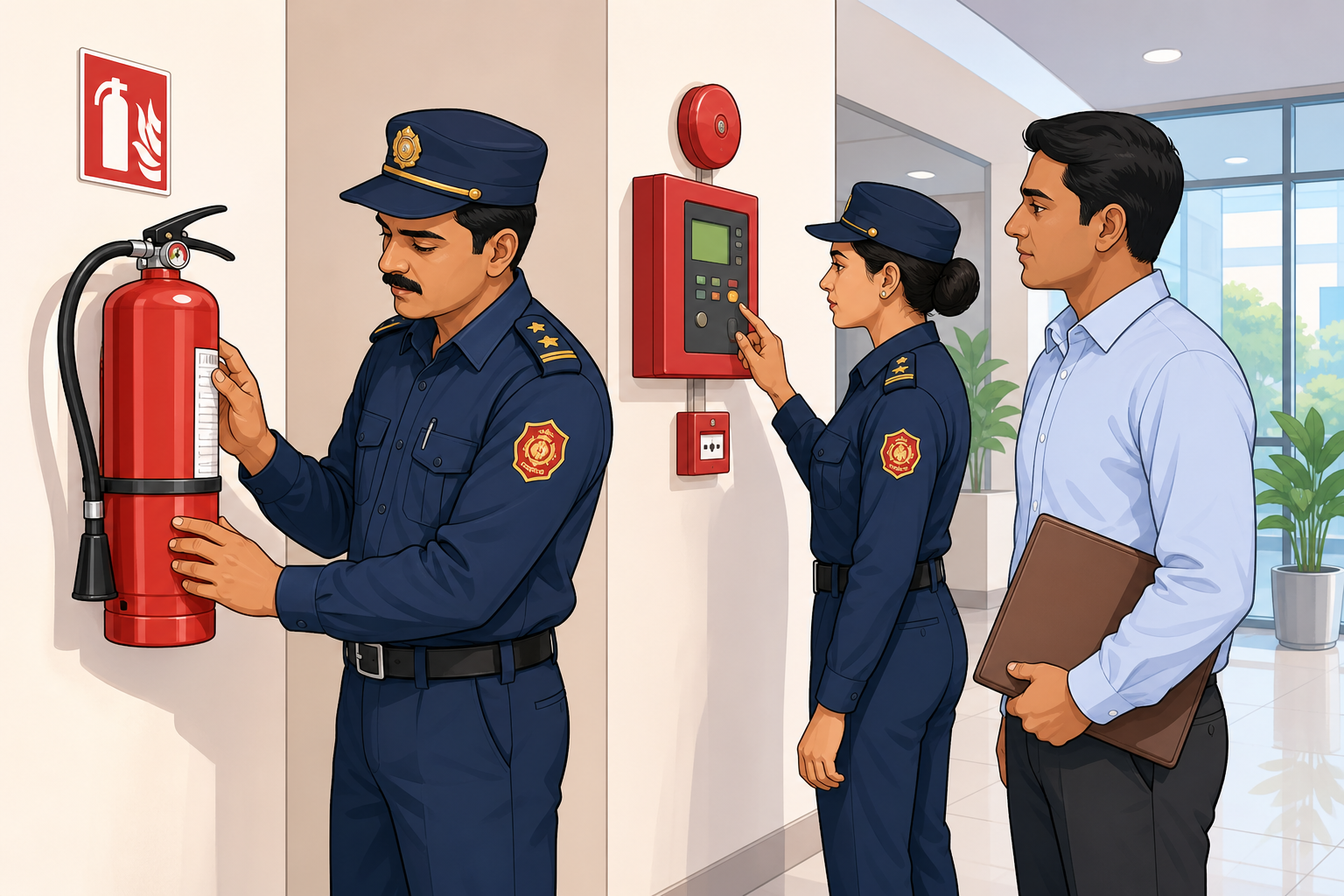
What Is FSCD?
FSCD (Fire Service and Civil Defence) is Bangladesh's national fire safety authority. It is responsible for fire safety inspection, fire licence issuance, fire NOC for construction, emergency response, and fire safety awareness. Every commercial building in Bangladesh requires a fire licence from FSCD.
Jurisdiction and Authority
| Aspect | Detail |
|---|---|
| Geographic scope | Nationwide — all 64 districts |
| Legal basis | Fire Prevention and Extinguishing Act 2003, Fire Prevention and Extinguishing Rules 2014 |
| Reporting to | Ministry of Home Affairs |
| Website | fireservice.gov.bd |
Key Functions
- Fire licence: Issue annual fire licences for commercial, industrial, and high-rise buildings
- Fire NOC: Issue No Objection Certificates for new construction (required before RAJUK approval for high-rise)
- Fire safety inspection: Conduct inspections of existing buildings for fire safety compliance
- Emergency response: Fire fighting and rescue operations
- Investigation: Investigate cause of fire incidents
- Training: Fire safety awareness and training programmes
Fire Licence Process
| Step | Activity | Documents Required | Timeline |
|---|---|---|---|
| 1 | Application submission | Application form, building plan, trade licence copy, fire safety equipment list, floor plans showing exits | Day 1 |
| 2 | Fee payment | Fee varies by building size and type (BDT 500-5,000+) | Day 1 |
| 3 | Site inspection | FSCD inspector visits to verify fire safety provisions | 2-6 weeks |
| 4 | Inspection report | Inspector documents findings — compliant or deficiencies noted | 1-2 weeks |
| 5 | Licence issuance | If compliant: fire licence issued. If not: rectification required before re-inspection | 1-2 weeks |
Total timeline: 1-3 months. Renewal: Annual. Fee: BDT 500-5,000+ depending on building category.
What FSCD Inspects
| Item | Requirement | Common Deficiency |
|---|---|---|
| Fire extinguishers | Appropriate type and quantity per floor, within travel distance | Wrong type (water near electrical), expired, insufficient quantity |
| Exit stairs | Minimum 2 exit stairs for commercial buildings, unobstructed | Single staircase, locked exit doors, storage in stairwell |
| Exit signage | Illuminated exit signs at all exits and along exit routes | Missing, not illuminated, or pointing wrong direction |
| Emergency lighting | Battery-backed emergency lighting in exit routes | Missing or non-functional battery backup |
| Fire alarm | Fire detection and alarm system (required for high-rise) | No system, or system non-functional |
| Sprinklers | Required for buildings above certain height (varies by occupancy) | No sprinkler system, or system not maintained |
| Fire pump | Dedicated fire pump with water storage | No fire pump, or pump not tested |
| Fire access | Clear access for fire vehicles to building entrance | Blocked by parking, construction, or vendor stalls |
| Electrical safety | No exposed wiring, proper circuit protection | Exposed wiring, overloaded circuits, no earthing |
| Gas safety | Proper gas line installation and ventilation | Improvised gas connections, no leak detection |
Fire NOC for New Construction
For high-rise and large commercial buildings, FSCD issues a Fire NOC during the design stage. This confirms the building design includes adequate fire safety provisions.
| Aspect | Detail |
|---|---|
| When required | Buildings above 10 stories or certain occupancy types |
| Documents | Architectural drawings, fire protection system design, exit plan, structural fire rating |
| Timeline | 1-3 months |
| Integration | RAJUK may require Fire NOC before issuing building plan approval |
Common Fire Safety Deficiencies in Dhaka
- No fire alarm system: Many commercial buildings (including multi-storey) have no fire detection or alarm system at all.
- Single exit staircase: Buildings with only one exit staircase — a critical life safety risk.
- Locked exit doors: Fire exits locked from outside for security — occupants cannot exit in emergency.
- Storage in exit routes: Stairwells and corridors used for storage, reducing exit width and creating fuel load.
- No sprinkler system: Even in high-rise buildings, sprinkler systems are often absent or incomplete.
- Generator in basement: Diesel generators in basements without proper ventilation or fire suppression create significant risk.
- No fire drill: Most commercial buildings have never conducted a fire evacuation drill.
Post-Rana Plaza and Tazreen Reforms
The Rana Plaza collapse (2013) and Tazreen Fashions fire (2012) transformed fire safety enforcement in Bangladesh:
- Accord/Alliance/RSC: International garment buyer-driven safety inspections — structural, fire, electrical — for RMG factories
- DIFE strengthened: More inspectors, mandatory remediation tracking
- FSCD capacity: Increased stations and equipment, but still significantly under-resourced for Dhaka's building density
- Commercial buildings: Non-garment commercial buildings have received less attention — the enforcement gap remains large
Practical Guidance
- For tenants: Ask to see the fire licence. Check fire exits yourself — walk down every staircase. Are doors locked? Is lighting working?
- For owners: Obtain and maintain the fire licence annually. Even if enforcement is inconsistent, the liability in a fire incident without a licence is severe.
- For FM managers: Conduct fire drills twice annually. Test fire alarm quarterly. Inspect extinguishers monthly. Keep a fire safety log.
- For MNC occupiers: Your global fire safety standard likely exceeds FSCD requirements. Apply your corporate standard, not just the local minimum.
References
- FSCD — Fire Service and Civil Defence Official Website
- Fire Prevention and Extinguishing Act 2003
- Fire Prevention and Extinguishing Rules 2014
- BNBC 2020 — Part 4: Fire Protection
- NFPA — Referenced by BNBC for fire protection standards
- ILO — Bangladesh Fire Safety Programme
Insights & Guidance
- Every commercial building in Bangladesh requires an annual fire licence from FSCD.
- Fire licence process takes 1-3 months: application, inspection, compliance verification, issuance.
- Most common deficiencies: no fire alarm, single exit staircase, locked fire exits, no sprinklers, storage in exit routes.
- Post-Rana Plaza reforms improved garment factory safety but commercial office buildings still have significant enforcement gaps.
- The fire licence is not just a compliance document — in any fire incident, its absence creates severe legal liability.
Fire is the most common catastrophic building safety failure in Bangladesh. FSCD is the authority responsible for fire safety — but enforcement capacity is limited relative to Dhaka's building density. This means building owners and FM managers must take ownership of fire safety, not wait for inspection. Understanding FSCD requirements, the inspection process, and common deficiencies is the starting point.
- No fire licence — building operating illegally, severe liability in incident.
- Inspection-only compliance — fire safety measures present during inspection but not maintained.
- False confidence — having a fire licence does not mean the building is fire-safe. Licences check minimum requirements.
- Current fire licence (displayed visibly)
- Fire safety inspection report from FSCD
- Fire extinguisher inspection log (monthly)
- Fire alarm test records (quarterly)
- Fire drill records (semi-annual)
- Is the fire licence displayed? Is it current year?
- Walk every exit staircase — are doors unlocked? Is lighting working?
- Check fire extinguishers — are inspection tags current?
- Is the fire licence current? When was the last FSCD inspection?
- When was the last fire drill conducted?
- Does the building have a fire alarm system? Is it tested regularly?
- Fire system design — fire protection engineer for sprinkler, alarm, and suppression system design.
- Fire risk assessment — NFPA-qualified assessor for comprehensive fire risk evaluation.
- FSCD liaison — local consultant experienced with FSCD application and inspection process.